
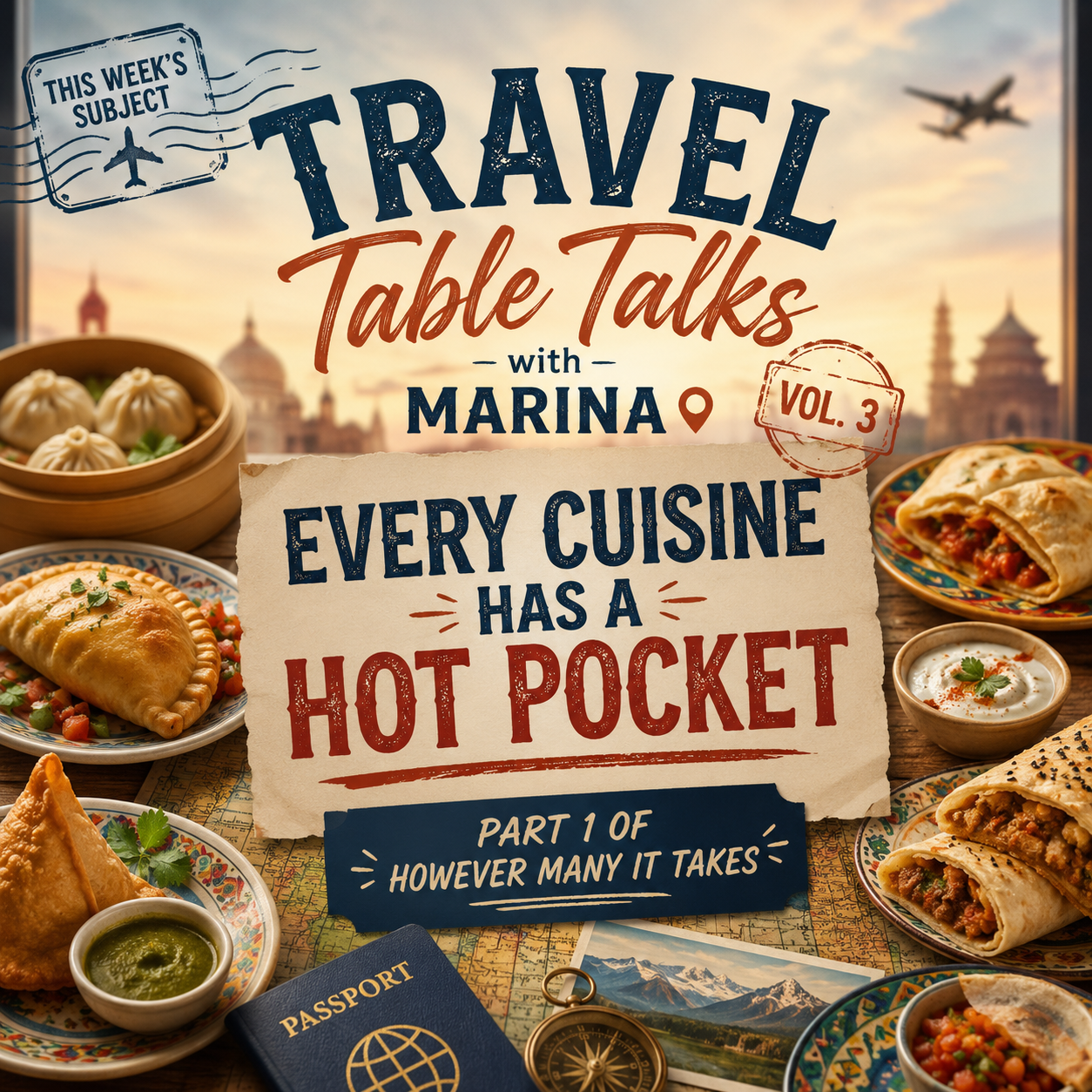
Travel Table Talks with Marina Vol. 3 - Every Cuisine Has a Hot Pocket - Part 1 of However Many It Takes
Every cuisine has a hot pocket. I figured that out teaching kids to cook and I have been eating my way around the world proving it ever since. Part 1 starts in Hawaii with the manapua, a story of Chinese immigration, a woman who changed everything in 1946, and a bakery in Honolulu Chinatown that is now holding the crown. And yes, I ate them on the plane home. No regrets.
About ten years ago I created and ran a mobile culinary education program called Lavender's Culinary where I taught kids and adults how to cook. I was in the middle of explaining what an empanada was to a group of kids and I was losing them completely. And then it just came out of my mouth. It is like a hot pocket. The whole room went ahhh. Suddenly there was a great equalizer and everyone understood. To this day whenever I find the hot pocket of a particular cuisine it makes me smile.
That moment has never left me. Because the more I looked at food in my various roles as Executive Chef, the more hot pockets I found. Empanadas. Ravioli. Samosas. Pierogi. Gyoza. Piroshki. Knish. The list is genuinely endless. Every culture, every cuisine, every corner of the world independently arrived at the same beautiful idea. Take something delicious. Wrap it in dough. Make it portable. Feed your people.
So this is my promise to you. Everywhere I travel I am going to find that cuisine's hot pocket, eat it, and tell you about it. The food, the history, the why and the how it got there. This series has no end date. It ends when I run out of world, which I do not plan to do anytime soon.
Part 1 starts where my story starts. Hawaii. And given that we are right in the middle of AAPI Heritage Month, the timing could not feel more right.
The Manapua Man
I grew up in Hawaii until I was nine years old. And like every kid on the island, I knew the sound of the manapua man the way mainland kids knew the ice cream truck.
The manapua truck was Hawaii's ice cream truck. Before food trucks were trendy, the manapua man beeped his horn and the whole neighborhood came running. You grabbed whatever change you could find and you ran. Shave ice for maybe 25 cents. Fried noodles in a waxed paper bag. And manapua. Warm, slightly sweet, impossibly soft steamed buns with bright BBQ pork inside. I know now that pork is called Char Siu. At seven years old I just knew it was the best thing I had ever eaten and it cost me about a quarter.
I left Hawaii at nine. I did not get back until last month. Forty six years later.
Chinatown, Honolulu. Sing Cheong Yuan Bakery.
I did my research before we landed, googling, asking locals and anyone really, who would entertain my query. Finding a bakery that still makes manapua the old way, has made them for decades, and is beloved by locals rather than tourists takes a little digging. The internet helps. So do good travel friends. Thanks to Justyn and Lawrence for pointing me in the right direction.
The address took us to Chinatown in Honolulu, one of the oldest Chinatowns in the United States. The Chinese who introduced manapua to the islands called it Char Siu Bao, sweet pork bun. But the Hawaiians called it mea ono, meaning pastry, and pua'a, meaning pork. Manapua. And Chinatown is exactly where it belongs. Chinese characters on the street signs and storefronts. Retail shops packed floor to ceiling. And the most incredible smells hanging in the air the moment you step out of the car.
We walked down the broken cement sidewalk to Sing Cheong Yuan Bakery at 1027 Maunakea Street. First visit there were about five people in line. When we came back on the way to the airport there were over twenty. I wish I could tell you it was a leisurely experience. It was not. This is not a place for dawdling. There were bins of spices and Chinese ingredients that any chef would want to stop and smell and examine for an hour. There was no time for that. They move you through and they are not apologetic about it.
I ate them in the car. Then I bought another package for the flight home and ate manapua at 30,000 feet somewhere over the Pacific. Honestly one of the better meals I have had on a plane.
Why Manapua Is Hawaii's Hot Pocket
Manapua is not just a snack. It is a whole story about immigration, adaptation, and what happens when cultures collide on a small island in the middle of the Pacific.
In the mid-1800s Chinese immigrants arrived in Hawaii, primarily from the Guangdong province, to work the sugar and pineapple plantations. They brought char siu bao with them as a practical field lunch. Portable, filling, cheap, and a taste of home in the middle of hard physical labor. After their plantation contracts ended many became merchants and food vendors, loading carts and later trucks with fresh steamed buns and driving through neighborhoods. The Hawaiian language gave it a new name. Mea ono pua'a. Delicious pork thing. Which might honestly be the most perfect food name ever given.
Then it evolved. In Hawaii the buns got bigger to serve as a standalone meal. The char siu filling got sweeter, with oyster sauce, honey, and a touch of red food coloring making it distinctly Hawaiian rather than strictly Cantonese.
And then there is Bat Moi Kam Mau. A woman, a visionary, and the person credited with creating the large format manapua we know today. She opened her shop Char Hung Sut in 1946 and changed the size, the format, and the future of manapua in Hawaii. We love a woman who builds something from scratch and feeds an entire culture while she is at it. During AAPI Heritage Month we especially love her.
It is a dying breed now. You do not see the manapua truck going down the road anymore in most neighborhoods. But the bakeries that have been making them for generations are still there if you know to look. And the locals who grew up on them never forgot.
Neither did I.
If you find yourself in Honolulu and want to try something genuinely local, known mostly to people who grew up there, and absolutely delicious, reach out. I will send you the link.
And if you have a hot pocket from your part of the world that I need to know about, tell me. I am building a list and I intend to eat every single one of them.
Eat curious. Travel intentional.
Ready to eat your way around the world? I plan trips for food lovers, cultural explorers, and anyone who wants more than a generic vacation. Let’s plan yours →
Warmly, Marina
2 Tacks Travel, LLC
Marina Tack, TAEC, CATA
Ocean & River Cruise Specialist
Office: 252-489-4553
Cell: 252-455-0144
marina.tack@avoyanetwork.com
www.2TacksTravel.com
“Dream it. Book it. Go!”
They're Counting on You Not Noticing
Let me tell you what I did with a random Tuesday afternoon recently. I picked Branson, Missouri. Not exactly the first place that comes to mind when you think about serious food. And I Googled this:
"In Branson Missouri what local organizations support farm to table restaurants"
Not "best restaurants in Branson." Not "where to eat in Branson." A complete question. Like a human asking another human who actually knows something. And here is what came back.
A 2025 Missouri Grown Farm to Table Award winner. A regional farmers market network. A college that runs its own farm to fund student tuition and feeds its own restaurant kitchen with it. A mill that operates as a restaurant. A state agriculture program that verifies and certifies local sourcing. An entire food infrastructure I never would have found if I had searched the way most people search.
Here is the uncomfortable part. It took me several tries to get there. Rephrasing, refining, pushing past the first page of results. And I will be honest with you; if I were a normal traveler with a normal amount of patience for this, I would have given up. Most people do. They land on Yelp, they read a handful of reviews about the pasta being good and the wait being long and they pick a place.
And that is exactly how you end up eating mediocre food in a city that had something genuinely worth finding.
Search Like Someone Who Knows Food. Not Like Someone Who Is Hungry.
Stop searching for restaurants. Start searching for the food system behind the restaurants.
Here is the exact formula. Go to Google and type:
"In [your destination] what local organizations support farm to table or local food sourcing"
or
"What farmer networks or food cooperatives operate in [your destination]"
What comes back is the infrastructure. The certifications. The verified partnerships. The organizations that actually hold restaurants accountable for what they claim to be doing. That is your map.
How to Read a Menu
Once you know what the local food system looks like a menu becomes a completely different document.
You are no longer reading it for what sounds good. You are reading it for what it reveals.
Here is what to look for:
Specific names beat vague language every time. A menu that says "locally sourced beef" is telling you nothing. A menu that says "beef from Harter House Quality Meats" is telling you everything. Specificity costs something. It means there is a real relationship behind that line. Vague sourcing language is marketing. Named partners are accountability.
Market fish deserves a closer look, not automatic suspicion. A rotating fresh catch changes daily and cannot always be named on a printed menu - that is actually a sign of a kitchen chasing what is freshest. But there should be something else there. A chalkboard. A server who can tell you exactly what came in that morning and where it came from. A verbal description that names the fish and sometimes the source. If you ask "what is the fish feature today" and the answer is vague or uncertain - that is the red flag. A kitchen that genuinely knows its fish knows it all the way to the boat. The menu does not have to say it. But someone in that room should be able to.
Menu length tells a story. A menu with forty options is not giving you more choice. It is telling you that nothing on it is particularly fresh or particularly intentional. A shorter focused menu with clear sourcing is a kitchen that knows exactly what it is doing and why.
"Inspired by" and "chef driven" are phrases that need scrutiny. Inspired by a regional dish is not the same as making that dish with regional ingredients. Chef driven sounds meaningful until you realize it means almost nothing without the sourcing to back it up.
Look for the certifications you already researched. In Branson that means the Missouri Grown logo. In North Carolina that means Got to Be NC and NC CATCH. Every region has a version of this. If a restaurant is genuinely connected to the local food system they will show you. They earned it. They want you to know.
Why Reviews Won't Tell You Any of This
I am going to say something that might be unpopular.
Reviews are not useless. But they are almost entirely useless for what we are talking about here.
A review tells you about someone's experience on one night with one server in one mood. It tells you the bread was warm and the hostess was rude and the tiramisu was worth it. It tells you nothing about where that bread came from, whether that fish was what the menu said it was, or whether that kitchen has a real relationship with a single farmer within a hundred miles.
Reviews measure experience. Menus reveal values. Those are two completely different things and only one of them tells you whether you are actually eating well.
The most well reviewed restaurant in any tourist town is often the most optimized for the tourist experience, not the best food. Those are almost never the same place.
The Branson Lesson
After everything Google gave me I went looking for which Branson restaurants were actually connected to those organizations. And I found them. Black Oak Grill names its bread source and its beef source directly on the menu. The Keeter Center at College of the Ozarks is running a farm to fork operation that funds student scholarships. The Ozark Mill is sourcing and educating at the same time.
None of that shows up in a star rating. All of it shows up if you know how to look.
Eat curious. Search smarter. Read the menu like it is trying to tell you something - because the good ones are.
And if you have questions about a destination before you go - just ask. Finding the good stuff wherever you land is exactly what I am here for.
Let me know how I can help.
Ready to eat your way around the world? I plan trips for food lovers, cultural explorers, and anyone who wants more than a generic vacation. Let’s plan yours →
2 Tacks Travel, LLC
Marina Tack, TAEC, CATA
Ocean & River Cruise Specialist
Office: 252-489-4553
Cell: 252-455-0144
marina.tack@avoyanetwork.com
www.2TacksTravel.com
“Dream it. Book it. Go!”
Your Food Is Lying to You
They're Counting on You Not Noticing
Travel Table Talks with Marina - Vol. 1 Your Food Is Lying to You
Let's talk about food for a minute - because this is something I care about deeply and think about constantly, both at home and everywhere I travel.
Pay attention to where your seafood comes from. I mean really pay attention. There are some serious quality issues happening at every level of the food industry right now and most of it flies completely under the radar.
If you are here in North Carolina, start with two things - the Got to Be NC label and NC CATCH partnerships. Look for them at the grocery store. Look for them on restaurant menus. These are not just feel-good stickers. They are your shortcut to knowing that what you are eating is actually what it claims to be.
And when you travel? Take two minutes before you go out to eat and Google the local food or farmer networks at your destination. Most regions have them. Seek out the restaurants and markets that carry those partnerships. The good stuff is out there - you just have to know to look for it.
Here is the uncomfortable truth. Restaurants are quietly cutting quality to protect their margins and the food supply overall is getting flooded with subpar products. Most people never notice. But once you know what to look for you cannot unsee it - and your plate will be better for it every single time.
I will be adding local food and dining notes to my client travel portals as a standard part of booking with me. Because knowing where to eat well at your destination is just as important as knowing where to sleep.
And if you have questions about any destination - just ask. I am always happy to share what I know.
Eat local. Eat intentional. Ask questions. The most well fed people I know are the ones who got curious first and asked questions.
Ready to eat your way around the world? I plan trips for food lovers, cultural explorers, and anyone who wants more than a generic vacation. Let’s plan yours →
Warmly, Marina